What is Fuuka Taisen?
What the hell is Fuuka Taisen?
If you’re like most people, you’re probably staring at the screen right now, and thinking “what the hell is Fuuka Taisen?” Maybe a few of you are thinking “Huh, Fuuka Taisen, I’ve seen some clips of that game…” These are the majority of reactions I expect from people, but there’s more to this game than just another anime fighter. Under the hood, this game is weird, cool, and has one of the most insane supers ever.
Okay but what is it actually?
Let’s start at the beginning. What is Fuuka Taisen? Well, it is (kind of) an anime fighter, based on the manga/anime series, Mai-HiME. Now, you’ll have to forgive me here, I am not personally well acquainted with the Mai-HiME series, so I’m coming at this game from the perspective of a fighting game fan, not a Mai-HiME fan.
As far as the game itself goes, it’s a fairly standard 3 button anime fighter, with a 4th button dedicated to the “Child” mechanic, an unfortunate name for a pretty interesting and unique mechanic. The reason I said this was only sort of an anime fighter earlier, is because characters vary wildly in their movement options, from characters like Midori with only one jump and no airdash, to our shoto protagonist Mai, who has a double jump and airdash. In addition to all the character specific movement quirks, the game is a fair bit more floaty and slow than your typical anime fighter. In all honesty, that aspect of the game’s feel turned me off of the game initially, but once you get used to the flow, it starts to make a lot more sense.
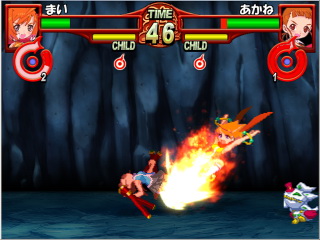 An image from the game files of Mai divekicking.
Art maketh the game
I’ll talk more about game mechanics in a bit, but let’s take a small detour to talk about one of this game’s defining traits, the art. One of the most famous aspects of the game is that all the art was drawn by Toru Nakayama, probably best known for his work on the Mega Man Zero/ZX series. He has an incredibly distinctive artstyle, and a lot of people only really know Fuuka Taisen as “that one fighting game with Nakayama art”. However, while yes, his art in the game is very pretty and I am a big fan of it, it is not the only beautiful thing about it.
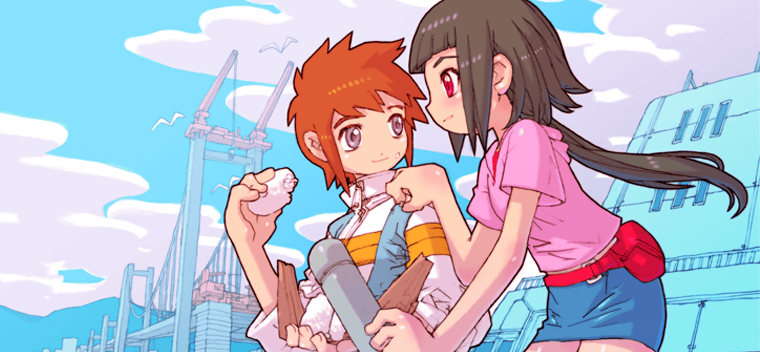 One of the story endings.
The spritework in the game is actually what initially drew me to it, and it cannot be understated how high quality all of the sprites are. I’m someone who tends to care deeply about a game’s aesthetics, and the sprites never fail to deliver for me, no matter which character it is. Fuuka Taisen also implements something I love aesthetically in fighting games, which is 2D sprites on 3D backgrounds. The backgrounds are a blend of 3D objects and 2D handdrawn sprites stacked in the 3D plane, and honestly, almost every background is beautifully rendered. There is no denying how gorgeous Fuuka Taisen is as a complete package… except for one small hangup.
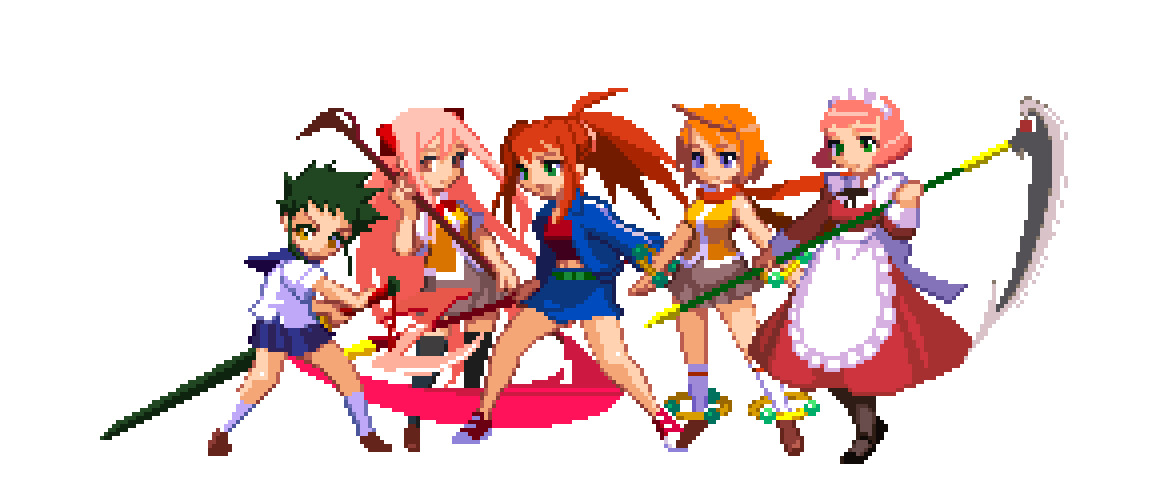 A lineup of sprites from the game.
The game’s HUD is maybe one of the ugliest HUDs I’ve ever seen in a fighting game. It has no style or real substance to it visually, and is about on par with the most boring of MUGEN HUDs out there, which is an unfortunate blemish on an otherwise gorgeous game. Luckily, I don’t decide the value of games by the HUD alone, so let’s shift back into what everyone really cares about in a fighting game, the gameplay.
Helium Fighter
Fuuka Taisen has a very weird feel to it that will turn a lot of people off immediately. Most characters feel as light as a feather, and in addition, the input reader has an incredibly small buffer, leading to a game that feels both light and slow at the same time. Once you get used to it however, you’ll run into another roadblock to anime fighter bliss, and that is the combo system. Combos are surprisingly tight in Fuuka Taisen, and while many characters have loops, finding combos on your own can feel like a hopeless task, as for many characters, their moves feel like nothing can connect after them. This combo system is, in my opinion, one of the main drawbacks of the game, as it tends to polarize much of the cast. Some characters have insane loops, or very anime fighter coded combos, while others can barely do more than 4 hits before having to settle for oki. It ends up feeling like half the cast is from a completely different game than the other half, and while they might be strong in their own right, it can be tough to see a character you visually enjoy only for them to not play how you might expect. Luckily, not every aspect of the game is as polarizing as its feel, and its Child mechanic is one of my favorite gimmicks in anime fighters.
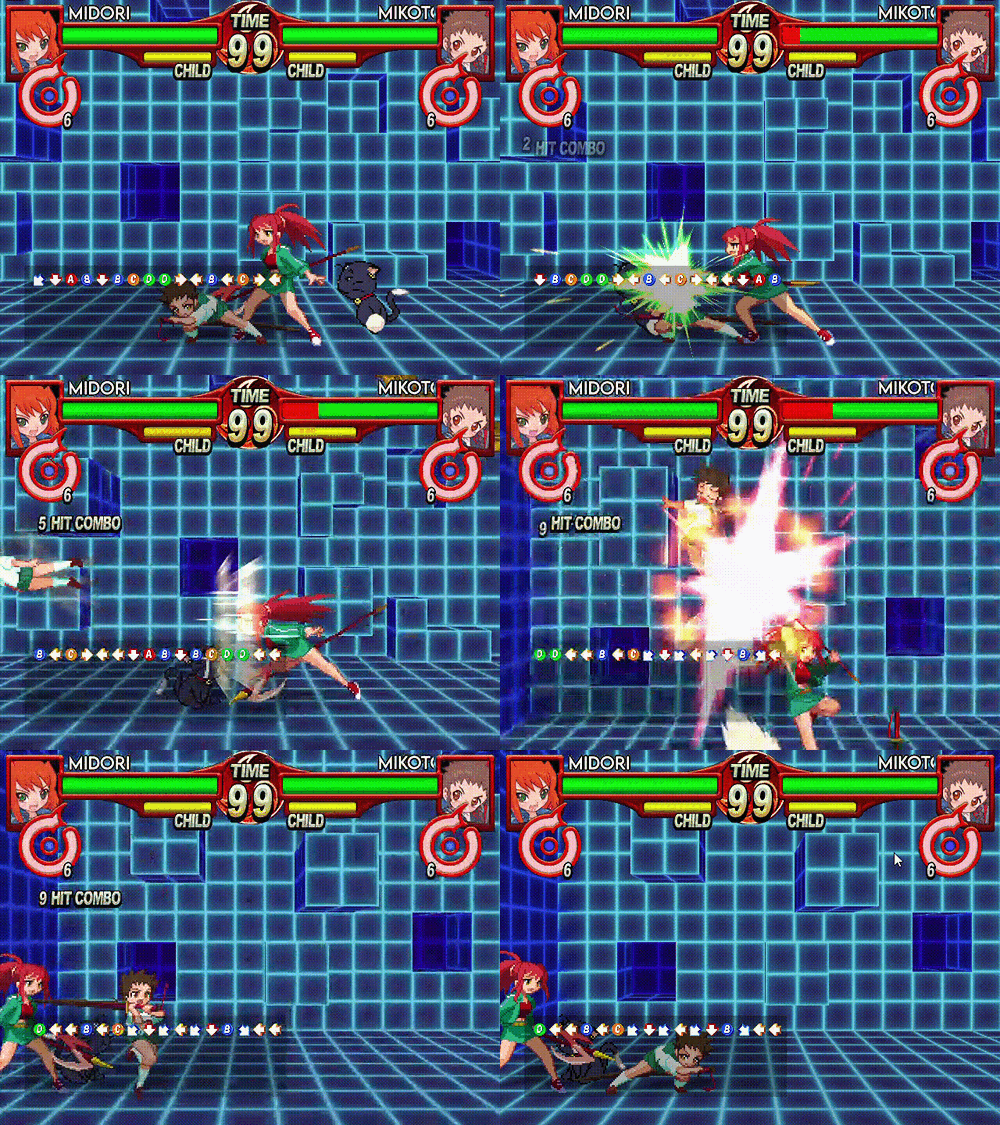 A BnB done by Parodx_LZT.
Why is it called that though
Yeah so, the Child mechanic is a bit unfortunately named in my opinion, especially when talking about the game forces you to inevitably say stuff like “Child meter”, but the gameplay is worth it I promise. Essentially, every character has a demon, or Child, that is used almost as Stands are in JoJo’s. Each character varies in how they use it, from Mai having a delayed fireball, Natsuki having a cannon wolf that allows for a lot of things, or Midori summoning giant tail whips from offscreen. This is, in my opinion, where most of the interesting elements of the game lie. The meter management of deciding when to use your Child for oki, or to extend a combo, or save it for later usage, leads to a lot of interesting plays in all aspects of the gameplay. I could probably go more in depth on the Child mechanic, but honestly, I think it’s something that is best experienced, rather than me just saying things.
Adding Bugs, Glitches, and an unfinished character
This is something that fascinated me when I first researched Fuuka Taisen, as these sorts of weird esoteric things tend to do. There are two main versions of Fuuka Taisen, and they are drastically different games. The one most commonly floated around in niche fighter circles these days, as well as the one with an English translation, is Fuuka Taisen Plus. While a lot of work has been put in by the community to fix bugs and repair unfinished characters, when Plus released, it was a broken hot mess of a game, that added a new character at the cost of breaking pretty much every single aspect of the game to a near unplayable state.
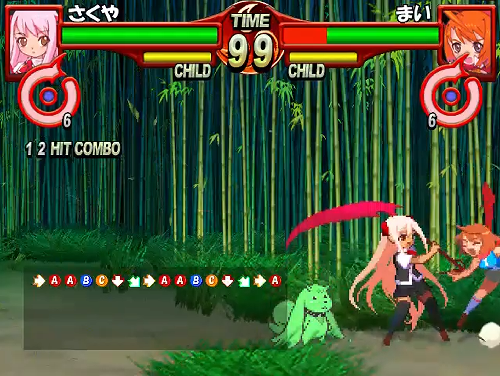 An image of Sakuya performing her infamous infinite (credit: Dr.Rook).
Even now, many people feel that Fuuka Taisen Plus is a lot less balanced and coherent as a game than the previous iteration. Now, the previous iteration, which took me a while to get my hands on surprisingly, is Fuuka Taisen 1.02 (5). From my personal experience, while Plus is more broken, it does feel a bit faster and more like what you would expect from an anime fighter, whereas 1.02 (5) is more consistent perhaps, but tends to be a bit slower and less combo heavy to play. At the end of the day, due to community effort, I think I personally prefer Plus a bit more, but it is an important distinction to make, and one I think most people miss about the game.
Fine, let’s talk about the sex super
Yeah, this is one of the other famous things about Fuuka Taisen, where the character Shizuru basically just has implied sex as one of her supers. It’s one of those things, where arguably that super is more famous than the character herself, but honestly after playing so many doujin fighters over the past few years, the shock of it has worn off a bit. Still, it is pretty funny to see people's first reactions to her super, and it’s something I think is notable enough to bring up in this review of the game. In addition, some of the ending art has some... questionable content, so just be aware going in that Fuuka Taisen is like that.
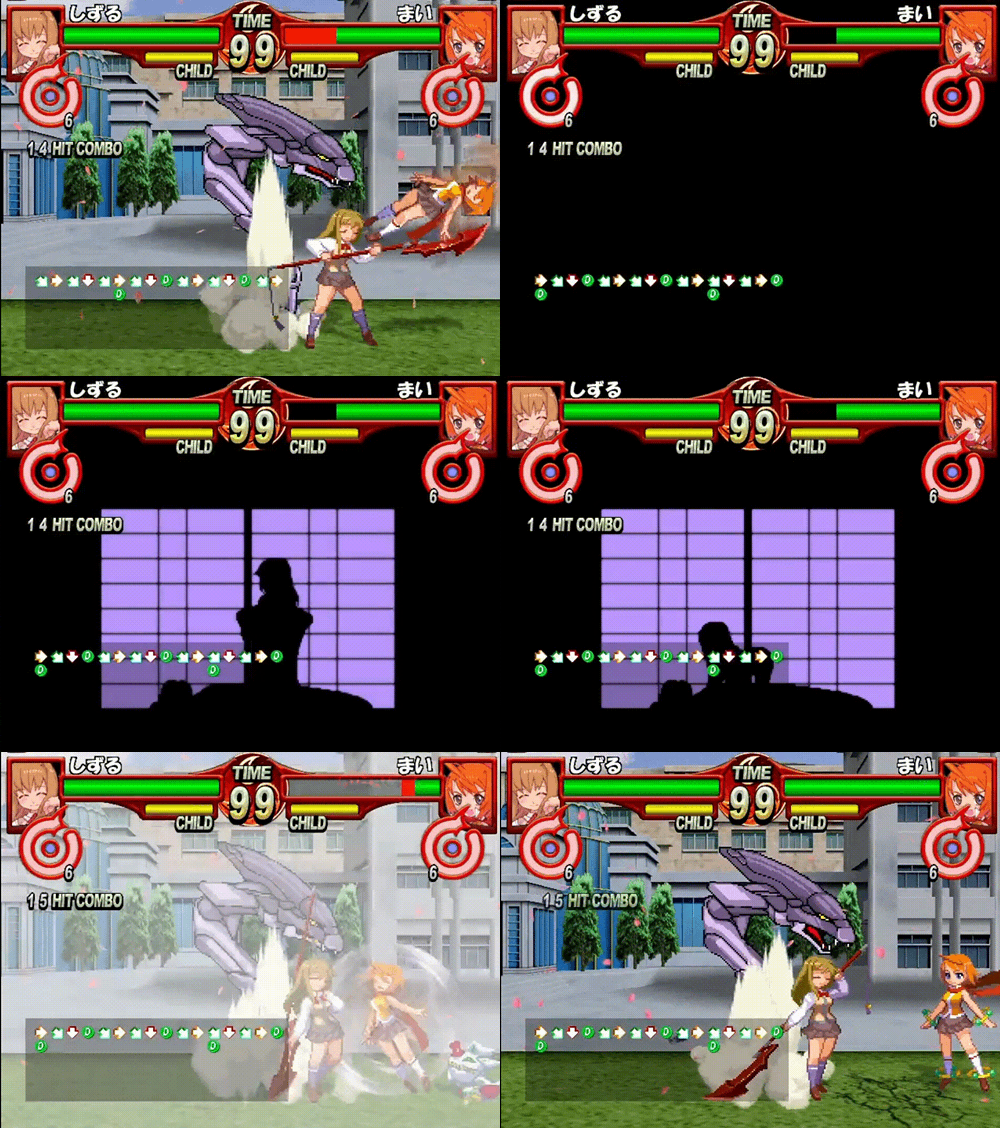 The infamous sex super...
So what’s the verdict?
Honestly, to this day I still struggle with Fuuka Taisen. I think it’s a game worth playing, no doubt in my mind about that, but at the same time, it feels awkwardly unique in a way I’m still not sure if I like or despise. If anything about this game interests you though, I recommend downloading the game for yourself and giving it a shot. It does have a lot of the weird game issues most old PC games do, so just be prepared for a bit of work getting it to play properly, but at the very least, it is an experience worth having.
If you made it this far in the review, lemme know what you thought of it on Bluesky! I appreciate feedback, and I’d also like to know if anyone ends up actually trying out the game because of this. I’m sure a lot of people expected my first post to be Big Bang Beat Revolve, but honestly there’s so much to talk about with that game for me that organizing my thoughts and also not writing 20 pages is hard, so it will probably end up being a bigger project down the road. Stay tuned for now, I’ll hopefully post some new content soon!
-Syrkle