What is Fate/Sword Dance?
Another Fate Fighting Game
For those of us in the doujin fighter realm, the Fate franchise comes up a lot more often than one might expect. Between full on fighting games like Crucis Fatal+Fake, Fate Unlimited Codes, and our topic today, to guest appearances in other franchise fighting games, such as Nitroplus Blasterz, and Melty Blood Type Lumina, Fate has a long history of being all over the doujin fighter community. Hell, French Bread even faked a Fate fighting game for a April Fool's joke (something French Bread and Fate fans have never really forgiven them for). So what makes Fate/Sword Dance stand out in this sea of Fate fighting games? Well, there's a lot actually, but let's start with the developer.
Rapid Fire
Fate/Sword Dance was created by a doujin circle that was known as Rapid Fire at the time. This was, as far as I can tell, their first fighting game ever, but it wasn't there last. In fact, Rapid Fire is a core piece of the history to my favorite doujin fighter series of all time, Big Bang Beat. You see, later on Rapid Fire rebranded to the name they're better known by, NRF, and created Big Bang Beat 1st Impression. This just proves my theory that every doujin fighter can be connected together, but that's neither here nor there. What is interesting about Fate/Sword Dance when compared to Big Bang Beat 1st Impression, is that they are pretty much complete opposites when it comes to their gameplay.
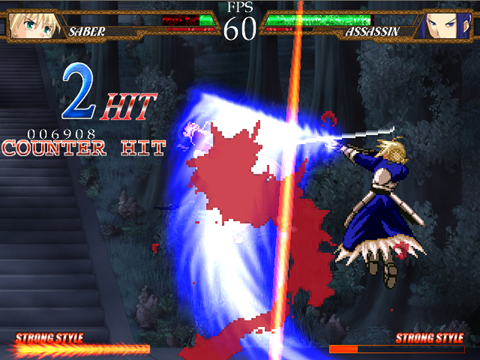 An image from the game files of Saber doing her DP.
Samurai Gear XX
Fate/Sword Dance on the surface is a fairly standard Guilty Gear clone, as many doujin fighters of the time were. You have four main attack buttons and an EX button the operates essentially the same as Dust in Guilty Gear does. However, the first main deviation is on the character select screen. When selecting a character, you have the choice between "Rush" or "Strong" style. Each one has a piece of a full anime fighter, so you never quite have all the tools you might expect. Strong allows you to cancel a special into a super, but only gives you a single bar of meter. On the flip side, Rush gives you 3 bars to play with, and gatlings as well, but cancelling a special into a super is impossible. Admittedly, this method of dividing up mechanics put me off the game at first. Combos in either mode feel like they're just missing one things to work, but they never quite do. However, with a bit of messing around, I found some decent combos, albeit they aren't as hectic as one would expect from a "Guilty Gear Clone".
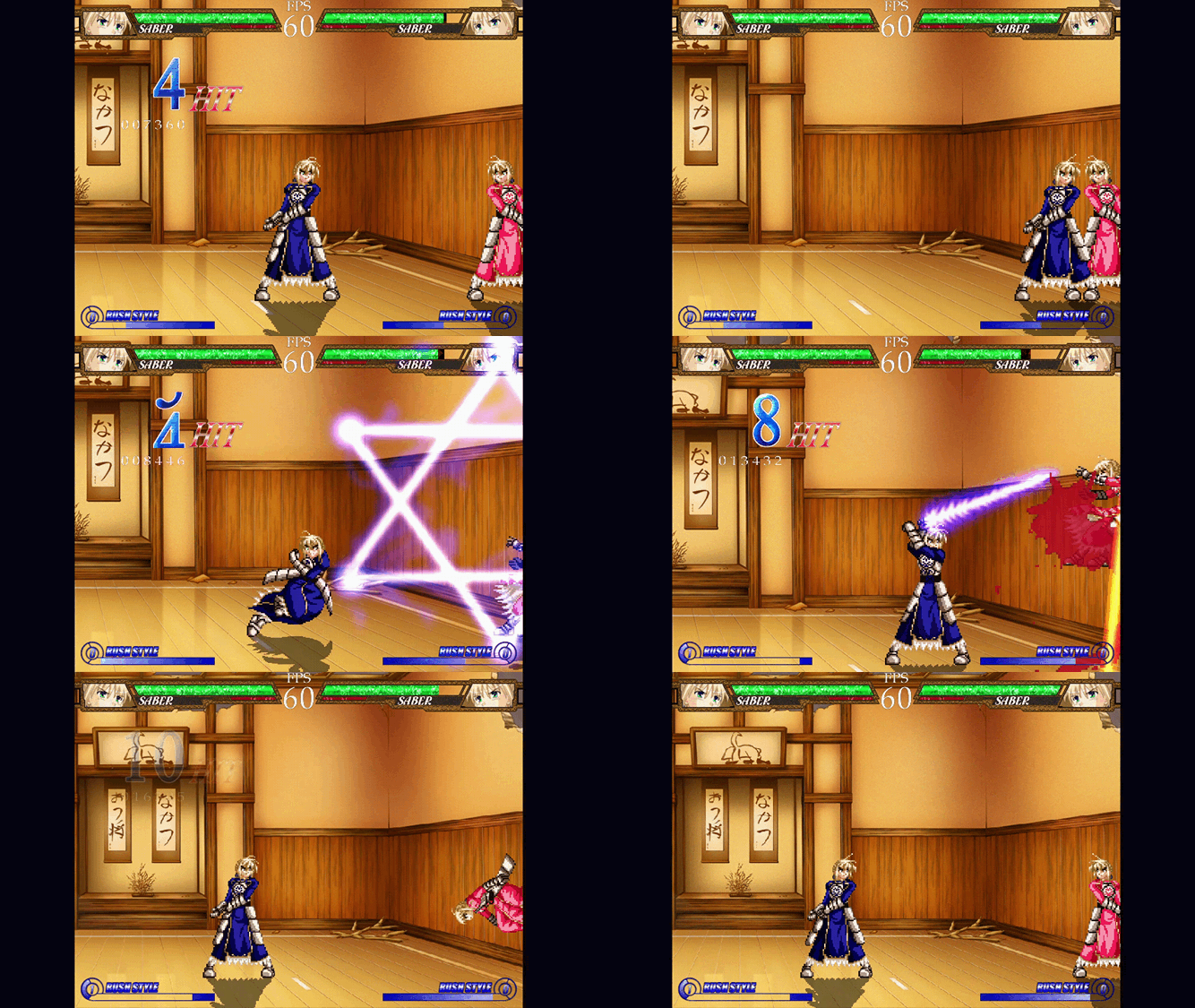 A basic Saber combo I found.
The Real Glory of Fighting Games
Fate/Sword Dance is hard to get a grasp on if you're used to jumping into training mode and labbing combos for hours. However, jumping into arcade or story mode and experiencing the gameplay for yourself will make the game make a lot more sense for you, or at least, it did for me. The tools of the game lead to a generally slower paced neutral, akin to something more like SamSho, with methodical neutral leading to only a few hits most of the time. Like SamSho, this game is best experienced by playing against an opponent, and it is where the game truly shines in my opinion. If you do want to try out the game, the way to do it is versus, as my descriptions really can't fully get across what the game feels like in combat.
Esoterica
I find it hard to write anything about this game that applies all the time. While the game only has 8 playable characters, each one is so different and unique that it's sometimes hard to find universal things. Assassin has a teleport dash, limited movement, but some of the better combos in the game and a rekka that leads into a dust combo. Rider has very limited combos, but plenty of strong zoning tools and lots of movement. Each character is so incredibly unique that honestly, just playing the game is the best way to figure out what's up with them. Suffice to say, even with only 8 characters everyone should be able to find at least one character they find interesting, it is an inevitability with a cast as varied as this.
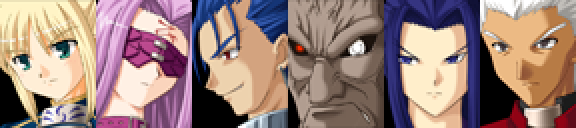 The main cast of Fate Sword/Dance, minus the two secret characters.
So what’s the verdict?
This game was really hard for me to break down, as for a long time, I played it with certain expectations in my mind of how a doujin fighter should play. If you come into this game expecting Guilty Gear, you will be very disappointed. No hitstun or hitstop, limited combo tools, and slower paced movement lead to this game being a lot slower paced than one might expect. But at the end of the day, I think that might be what makes this game so special. In a sea of doujin fighters that all feel similar, Fate/Sword Dance doesn't feel like anything I've played before. It's an anime fighter shell filled with SamSho gameplay, and I'm kinda into it. I recommend at least giving the game a shot if you're interested, it is at least worth a look beyond just "another Fate fighting game".
If you made it this far in the review, lemme know what you thought of it on BlueSky! I appreciate feedback, and I’d also like to know if anyone ends up actually trying out the game because of this. Shoutout to MrMKL for playing the game on stream, it did genuinely help in collecting my thoughts on this game. Next week has already been decided, I want to talk about Alice Senki 2, a game that will probably be just as hard for me to collect my thoughts on. Wish me luck please... And stay tuned, I might try to stream again soon!
-Syrkle